
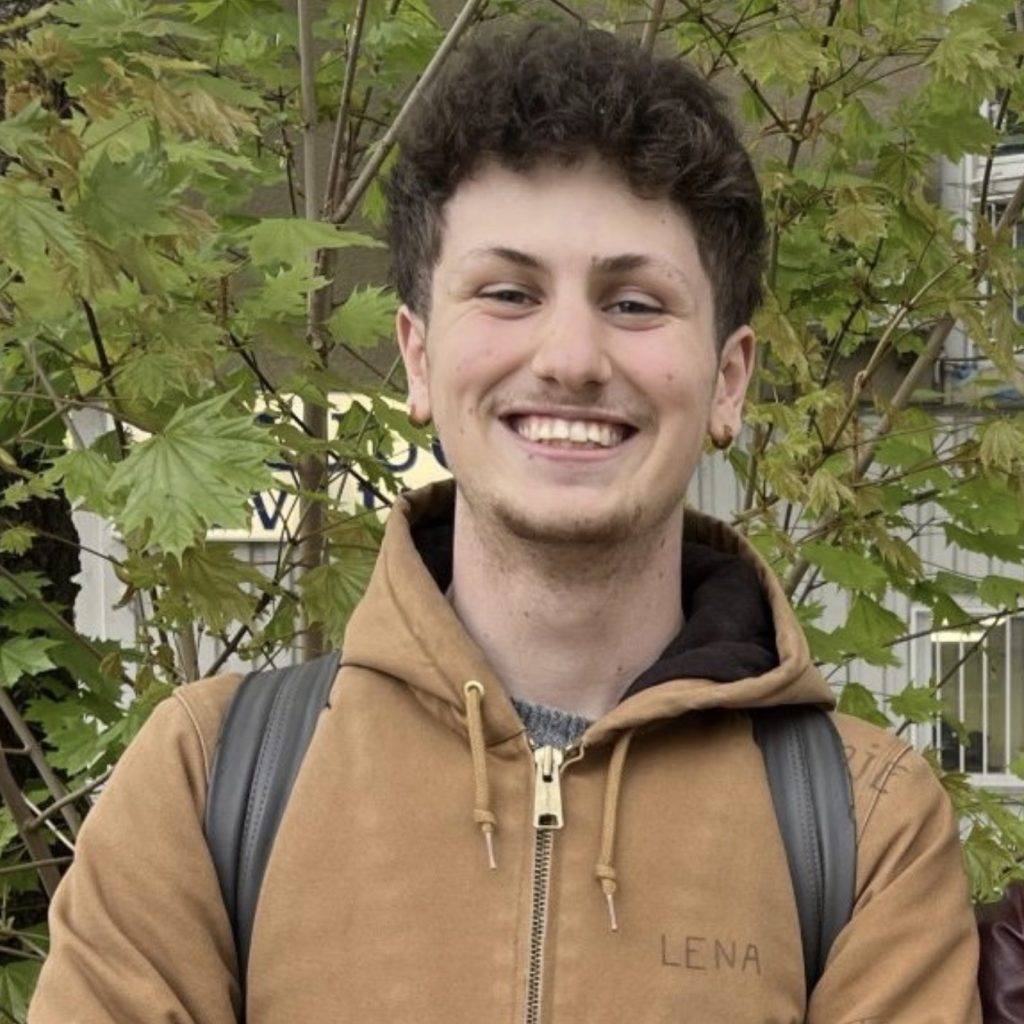
Ruben Buysse
social work student
Lovecrimes
13. 5. 2026
I got a “no” on my street action.
I imagined having a table and two chairs. One filled by me, one empty. A poster inviting strangers passing by to join me and talk about what queer culture means to them. I could imagine getting dirty stares. I could imagine that people might not join me. I could imagine people being angry, or that I would fail, or would have a big argument. What I didn’t expect is that when I asked if I could do this, the answer was no because it’s not safe. Not here. Not on the street. Not as a queer man. For me this raised the question: When will it be?
I’ve never been physically assaulted as a queer man; this is a huge privilege many of my peers do not have. I’ve been called names in passing by. My sexuality has been something that influenced the way people interact with me, or how they would describe me. Once I was added to a WhatsApp group where young boys, I used to be friends with, were exchanging screenshots of my Instagram profile to laugh at it. Using my sexuality as a slur. Using my looks as entertainment. But I’ve never been physically assaulted.
Nonetheless, I’ve never felt safe.
Most strangers could just look at me and know I liked boys. They even knew before I did. So, I didn’t have to come out to a lot of people. But every time I did, to my best friend or my mom, I got met with the same reaction. “You shouldn’t say it to everyone.” “You shouldn’t dress provocatively at a party, or someone might beat you up”
I was 15 years old, and the first reaction to my sexuality was people being scared they might lose me because of it. That they were scared I might be violated. I’m now 21 and I’ve still never danced the night away because I am always too conscious of how and where I dance. I’ve been fearful of acting gay around my own friends. I’ve never got drunk so I could still run away if I need. The fear I experience is not something that was implanted by hate crimes, it was something done by acts of love.
The point of a hate crime is to damage or destroy the subject. By committing it, the perpetrator tries to get a queer person out of the public space. It can be murder. But if someone is beat hard enough it has the same effect. With every hit enough fear can be evoked that the queer victim indeed avoids public spaces.
By spreading this fear on social media or to the people we love, we make it bigger, making the hate crime more successful. According to the Williams institute: queer people are five times more likely than non-queer people to be victims of violent crime. In a group of 1000 queer people, 106 of them will be a victim. But I believe all queer people are affected by the fear.
Fear implanted by both their haters, and their lovers.
This is not me saying that you shouldn’t try to protect the people you love. This is also not me saying that hate crimes should not be documented, or people should not be informed.
But the question I want to raise is when will we know it is safe? How will we know the war is over if the bunker has no windows? What is safe enough for us?
Safe spaces are never 100% safe. There is always a risk. But risk can be managed, risk can be reduced it just can’t be eradicated. Being queer comes with a risk. Defending that queerness comes with taking that risk.
I believe we can still take over the public space without being unsafe if we are supported by our allies, by our loved ones. We need to prepare for risk, not avoid it. We should be fearing the enemy, not his bigger shadow. By working around the risk and balancing between what we are comfortable with and what we want to achieve, we can make hate crimes just a little bit less successful. For example, I will do my street action in a gay bar instead of on the street.
Lastly, to finish this article off I want to leave you with a lesson I’ve learned from my loved ones.
I am a rainbow kid. A kid born to a family that lost a child. That family will be scared all their life to lose another. They will lock more doors and will allow less risk than other families. But living in fear is not living at all. To love a child, to love a queer, is to let them walk out, and accept our fear.
And giving them a helmet, just in case.