Zavod Moja mavrica
Zavod Moja mavrica
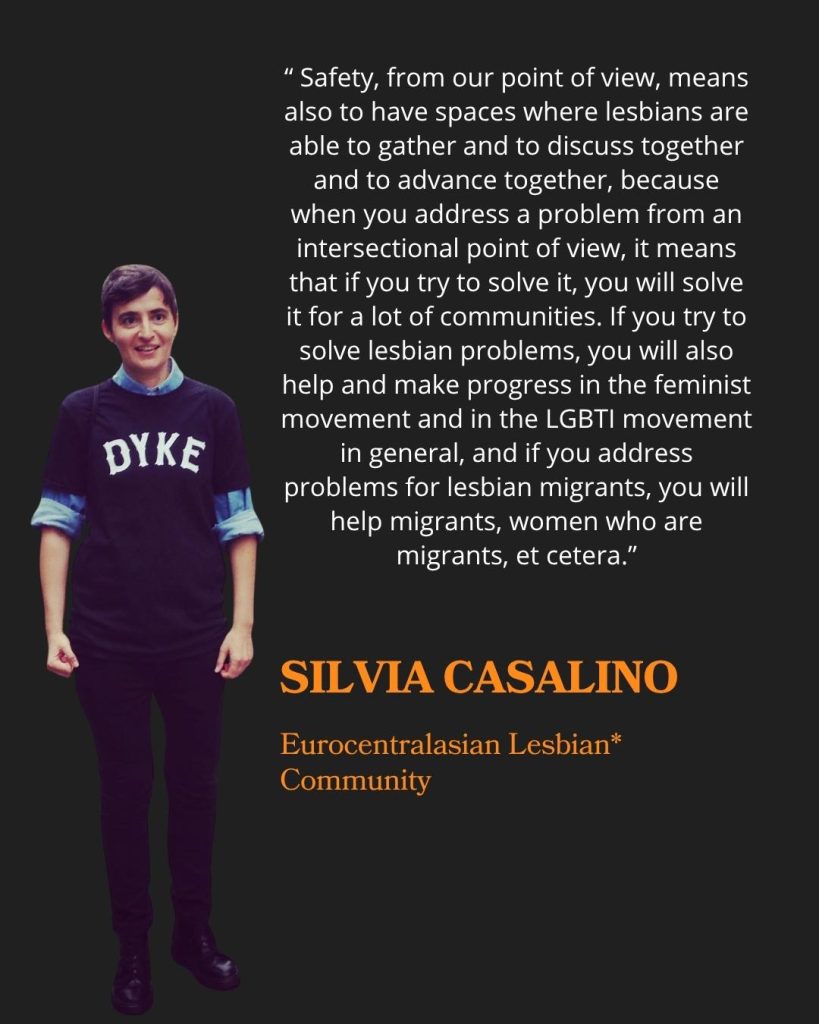
Silvia Casalino
Eurocentralasian Lesbian* Community
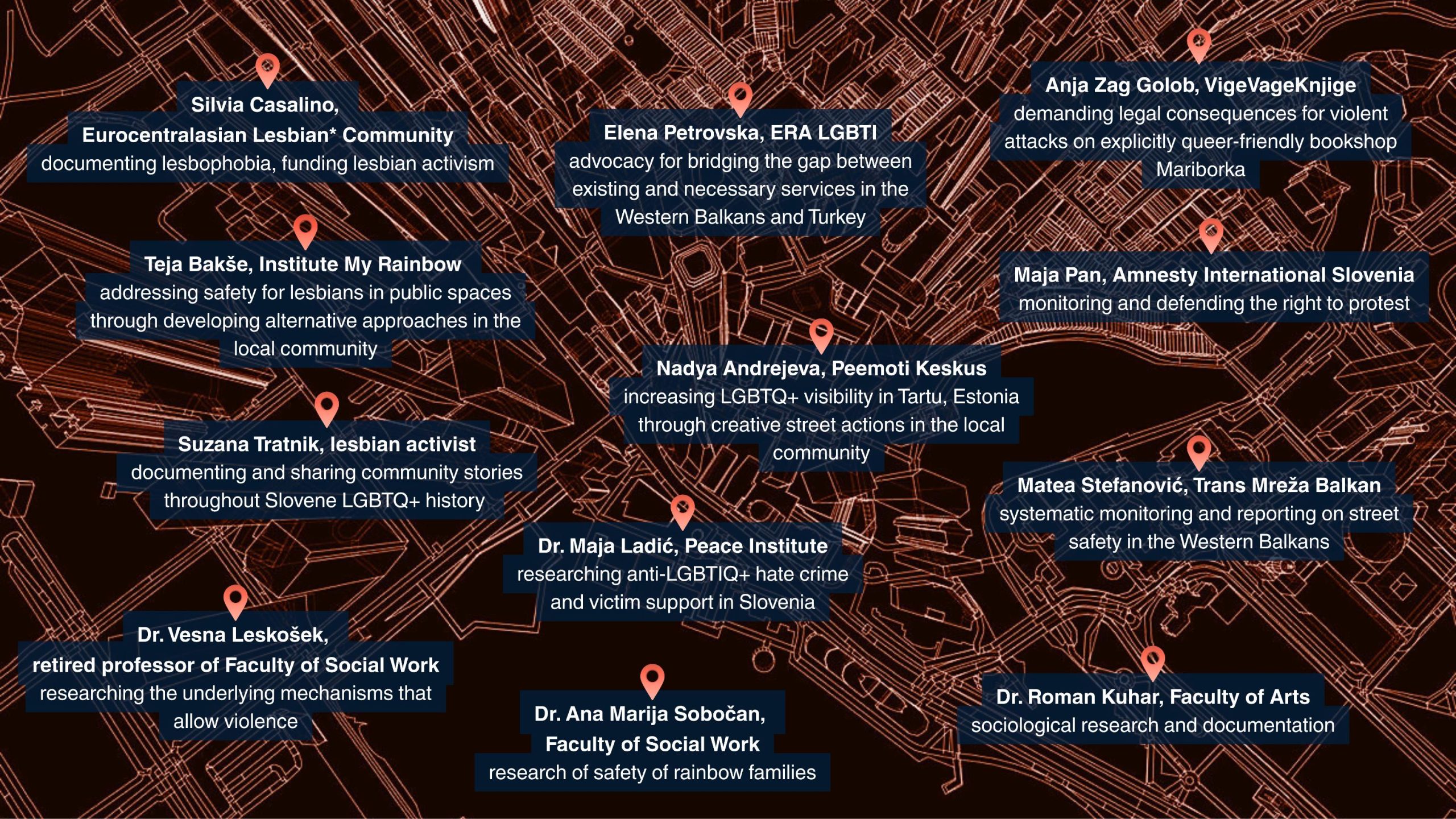
The EL*C addresses the specific safety needs of lesbians by making their unique experiences visible within the broader LGBTI and feminist movements. Lesbophobia often falls through the cracks of general human rights reporting, leaving violence, from harassment in schools to femicides, unaddressed by political authorities. The EL*C advocates for the collection of specific data to ensure that lesbians are not erased from safety discourses and that institutional responses are tailored to the intersectional nature of their lives as both women and non-heterosexual individuals.
A central part of the work involves creating and sustaining autonomous spaces where lesbians can gather safely to build political and economic power. The establishment of these spaces is a form of social empowerment that provides a necessary buffer against public and private hostility.
Their approach emphasizes that while visibility is a political tool, safety must be managed through global solidarity and the creation of “safer spaces” where the community can exist without the constant burden of hyper-vigilance.
The EL*C has provided over 3,5 million euros for funding for lesbian projects. We warmly recommend membership, which is free of charge, to any lesbian organisation looking to connect, network, increase their capacity for activism and organisational growth.
How to become a member: https://lesbiangenius.org/membership/
The observatory on lesbophobia 2025: https://lesbiangenius.org/the-2025-observatory-on-lesbophobia-report/
Current opportunities for funding: https://fund.lesbiangenius.org/
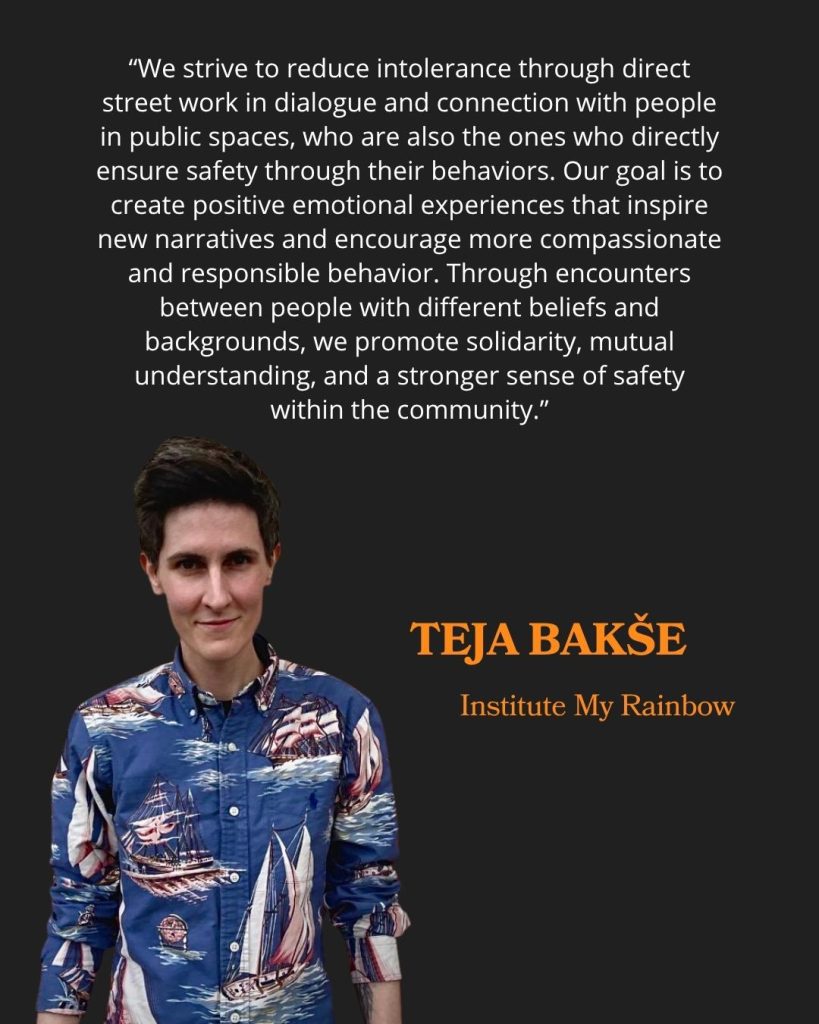
Teja Bakše
Institute My Rainbow
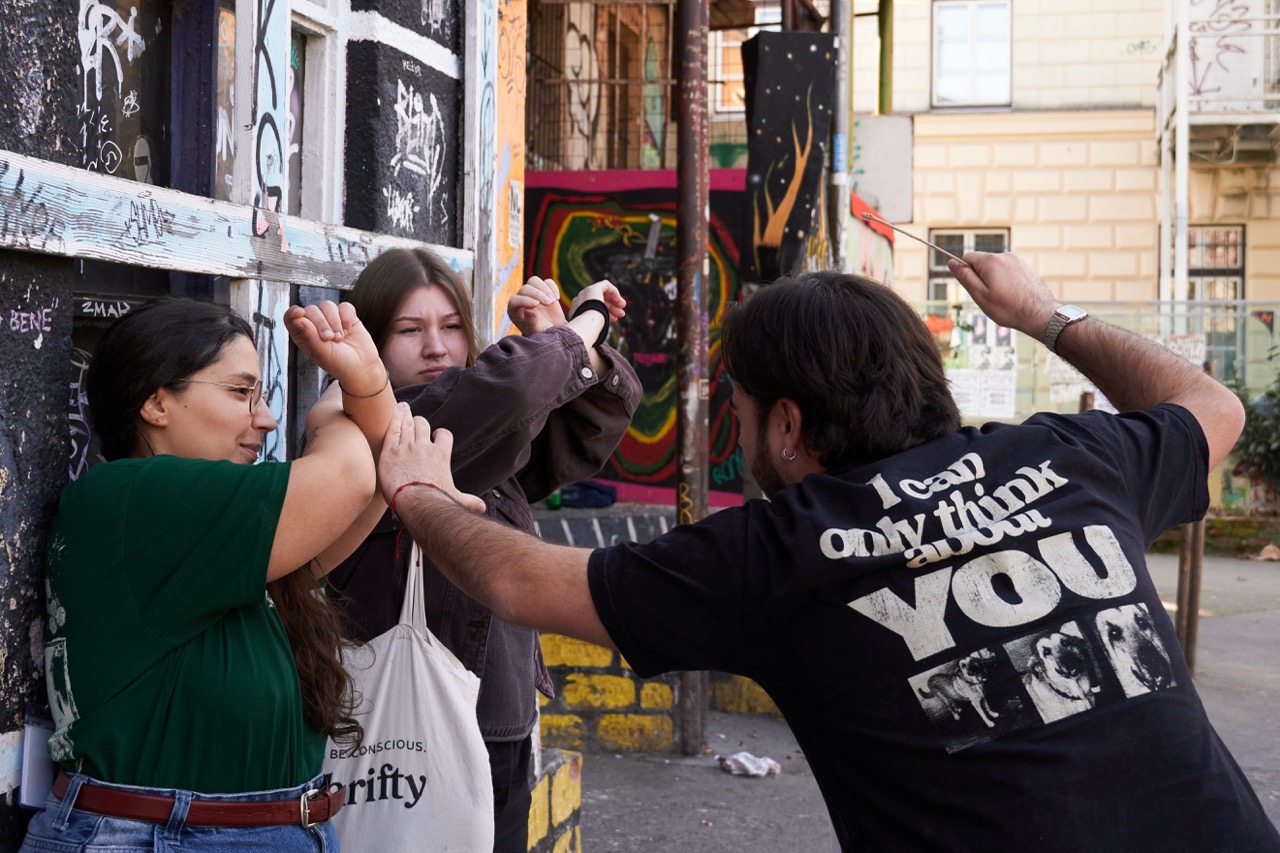
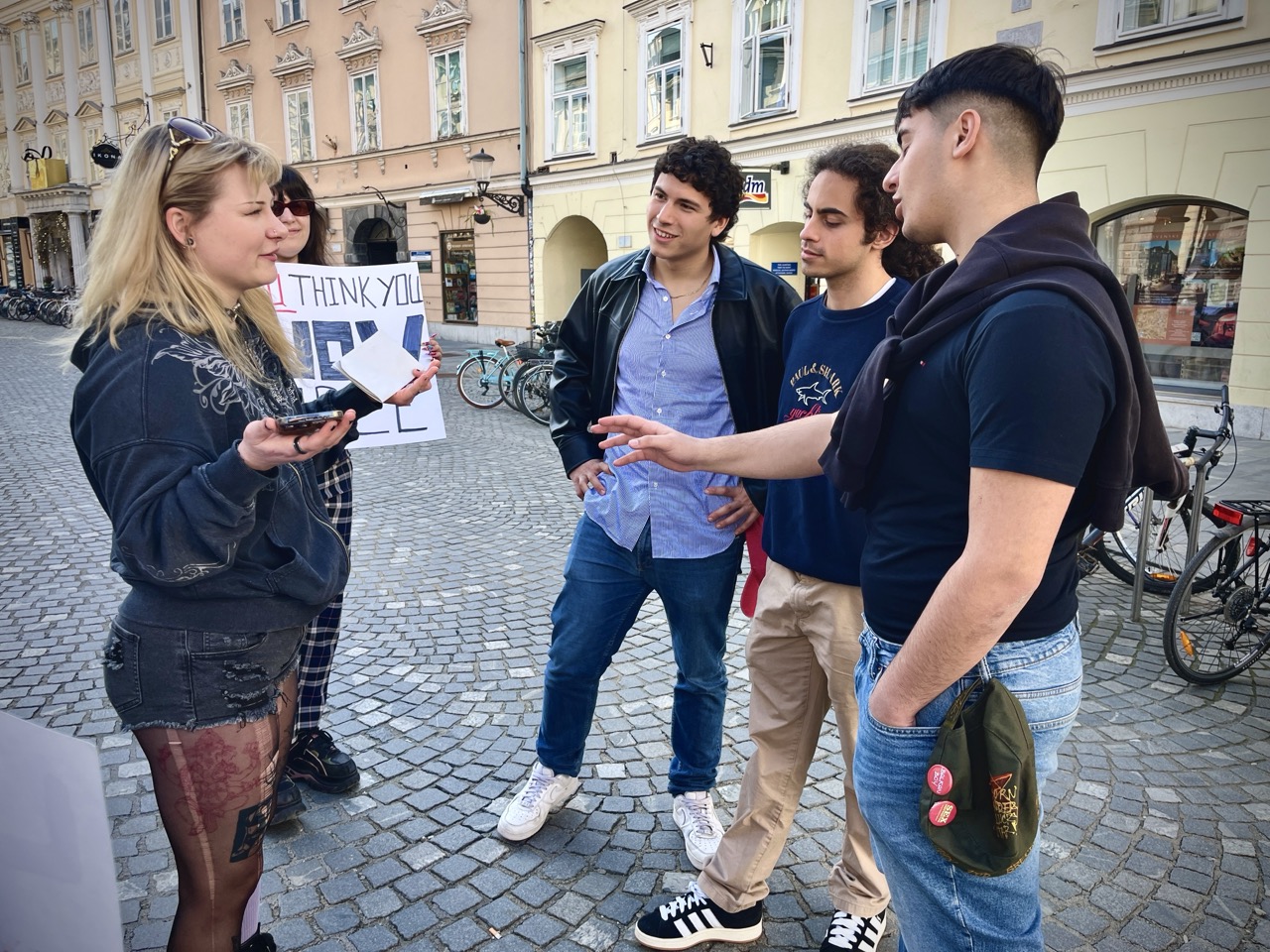
Teja Bakše, Executive Director of Institute My Rainbow, contributes to safety in public spaces through creative and innovative street actions as a primary method for building community resilience and public safety. Street actions are a methodology that prioritizes direct dialogue with the general public through playful, informal activities designed to encourage positive emotional connections. By establishing a shared space of comfort (like playing games) before introducing difficult topics or challenging specific prejudices, we create an environment where more compassionate and responsible engagement can occur. Being visible in public is an act of confidence that shifts power dynamics; it asserts a presence in the space rather than seeking permission to exist.
This approach also highlights the strategic importance of involving allies in public actions to model tangible solidarity. By integrating heterosexual and cisgender individuals into street work, we provide a visible example of mutual support that bystanders can emulate in their own circles. When addressing reactionary violence or the destruction of community symbols, like rainbow flags, Teja advocates for a persistent and public response. By immediately and repeatedly replacing a damaged flag or sign, we can show that reactionary behavior is ineffective, sending a message that the community refuses to be silenced.
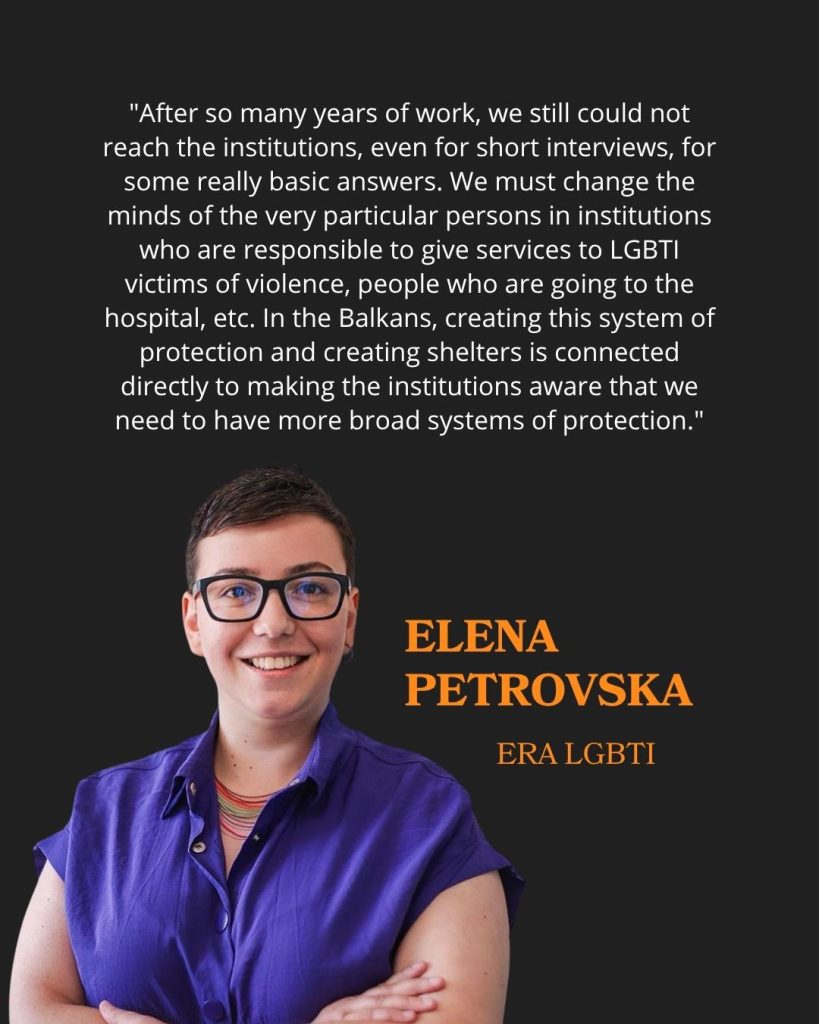
Elena Petrovska
ERA LGBTI
Elena focuses on the essential role of sustainable, community-based services in ensuring the physical and psychological safety of LGBTQ+ individuals. Her work centers on the “units of care” that step in when state systems fail, such as the emergency shelters she has helped manage in the Western Balkans. Safety is fundamentally tied to the existence of these support systems, which provide a first point of contact for victims of violence who often distrust police or other state institutions. It also includes access to basic healthcare and specialized medical services, which are frequently denied through institutional neglect.
In ERA’s advocacy work, she works to bridge the gap between institutional rigidness and the lived reality of marginalized communities. They facilitate national dialogues to sensitize social workers, healthcare professionals, and law enforcement to the specific needs of queer people, particularly trans individuals who face high levels of double vulnerabilization.
Elena also noted the critical role the media plays in shaping public safety, warning that the sensationalist de-anonymization of queer lives can lead to digital and physical harm.
The unity of the movement is itself a tool for safety, providing an ecosystem of support that state systems often lack.
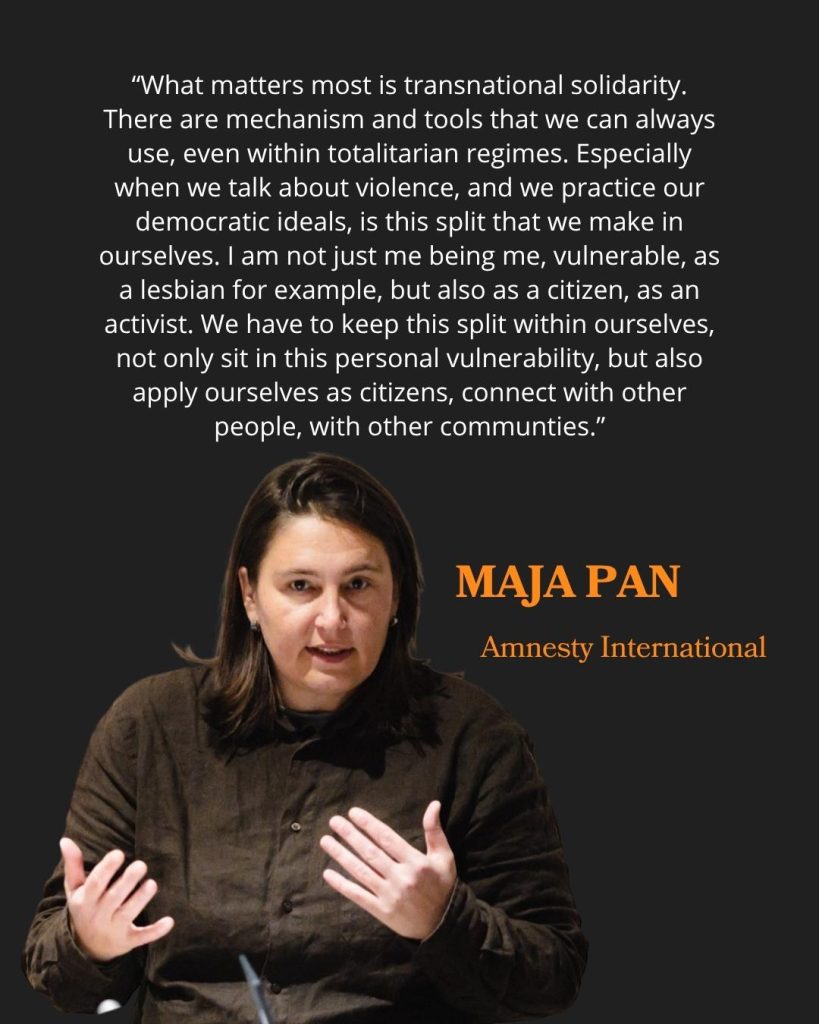
Maja Pan
Amnesty International Slovenia
Maja Pan addresses public safety by defending the right to protest and assembly as a primary tool for holding power accountable. Amnesty’s work involves the practical monitoring of police conduct and public events to ensure that the streets remain a safe space for political expression. By training volunteers to act as impartial observers, they provide a community-based service that documents the interactions between the state and the public, creating an objective record that can be used in court to protect the rights of protesters. This work serves to safeguard the constitutional freedom of assembly, especially during periods of political repression or institutional overreach.
Maja highlights the importance of transnational solidarity as a resilience tool, especially for those living under authoritarian regimes. Protest monitoring is a way to practice “citizenship” that transcends personal vulnerability, focusing on the collective exercise of democratic rights. Even in the most difficult political climates, the act of reaching out to others and sharing resources is what sustains a movement. Maja advocates for the use of practical tools, such as legal guides and monitoring networks, to turn public space back into a site where citizens can safely exercise their right to be heard.
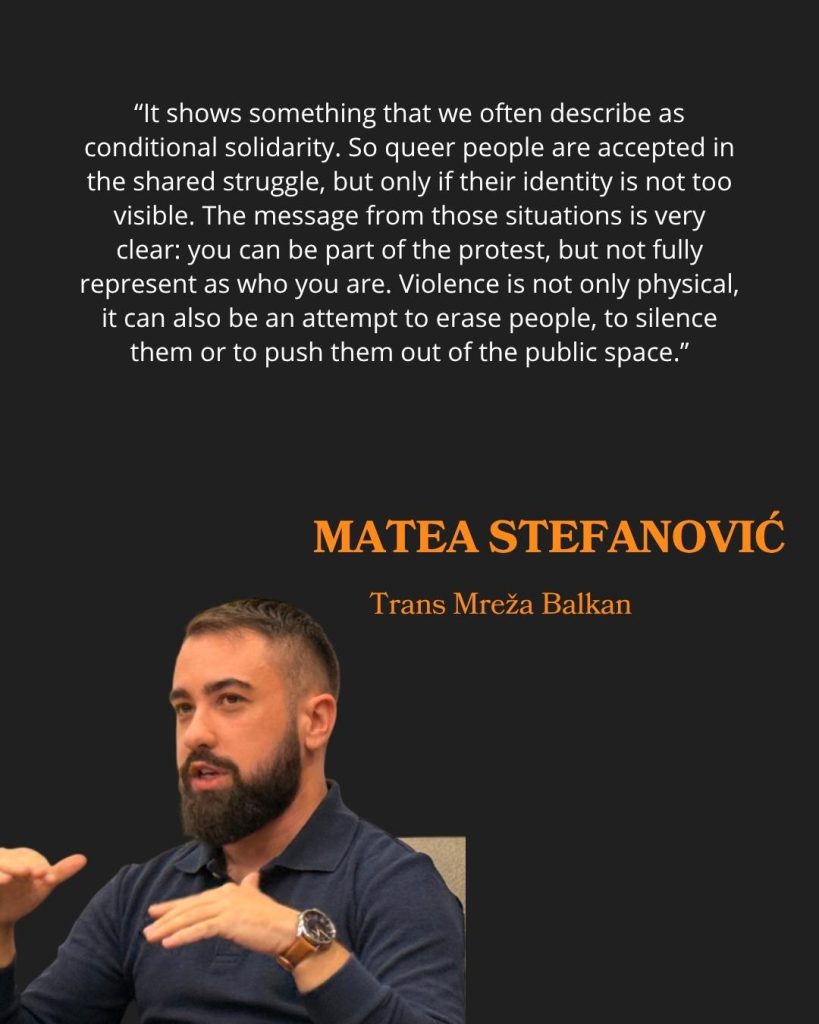
Matea Stefanović
Trans Mreža Balkan
Matea Stefanović, programme assistant at Trans Network Balkan, addresses queer safety through the systematic monitoring and documentation of social and political relations across the Western Balkans. In his work, he treats the street as a barometer for institutional protection, tracking how marginalized groups are treated in Serbia, Croatia, and North Macedonia. Through a presentation of case studies about street safety for queer people in the Balkans, he identified conditional solidarity as a major barrier to safety, where queer individuals are accepted in broader social movements only on the condition that their identities remain invisible. This systemic erasure, coupled with sensationalist media reporting, creates a landscape of heightened vulnerability that persists even without direct physical confrontation. Public visibility often comes with a risk for increased targeting of marginalised groups, because it is a tool that exposes prejudices related to homophobia and transphobia which were already present in society.
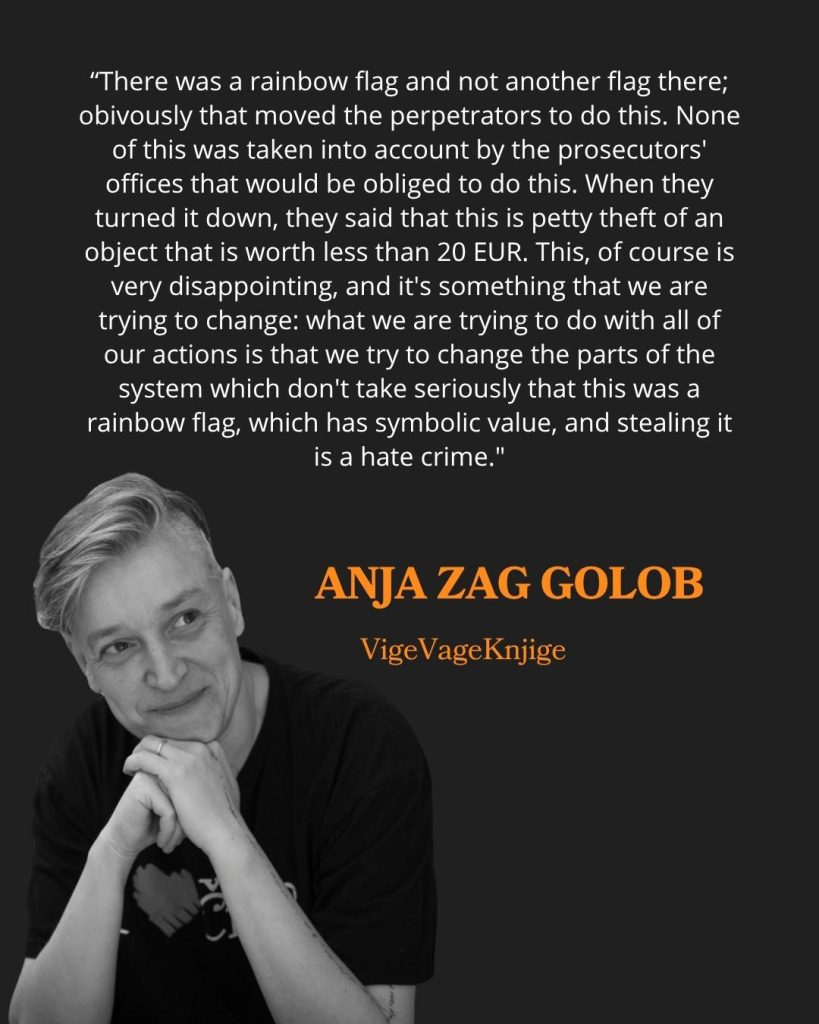
Anja Zag Golob
VigeVageKnjige
Anja Zag Golob addresses safety by treating the local environment as a site of direct legal and symbolic struggle. Through her management of the Mariborka bookshop, she transforms a bookshop into a public statement on equality and the right to visibility. Her work involves a refusal to hide symbols of identity, even in the face of physical threats and the destruction of property. When institutional responses fail, she uses the power of the press and public communication to hold the police and the judiciary accountable, demanding that symbolic violence and hate crimes be prosecuted with the same seriousness as physical attacks.
Her approach to safety is based on transparency and the refusal of silence. By turning incidents of vandalism into “artworks” and inviting high-level political figures to participate in community actions, she forces the public to acknowledge the violence that is often ignored by the state. While hiring security is a necessary and painful adaptation, the long-term solution lies in multiplying visibility across the city. She works to normalize the presence of the rainbow flag in Maribor, advocating for a collective display of symbols that makes it impossible for the community to be targeted as an isolated exception.
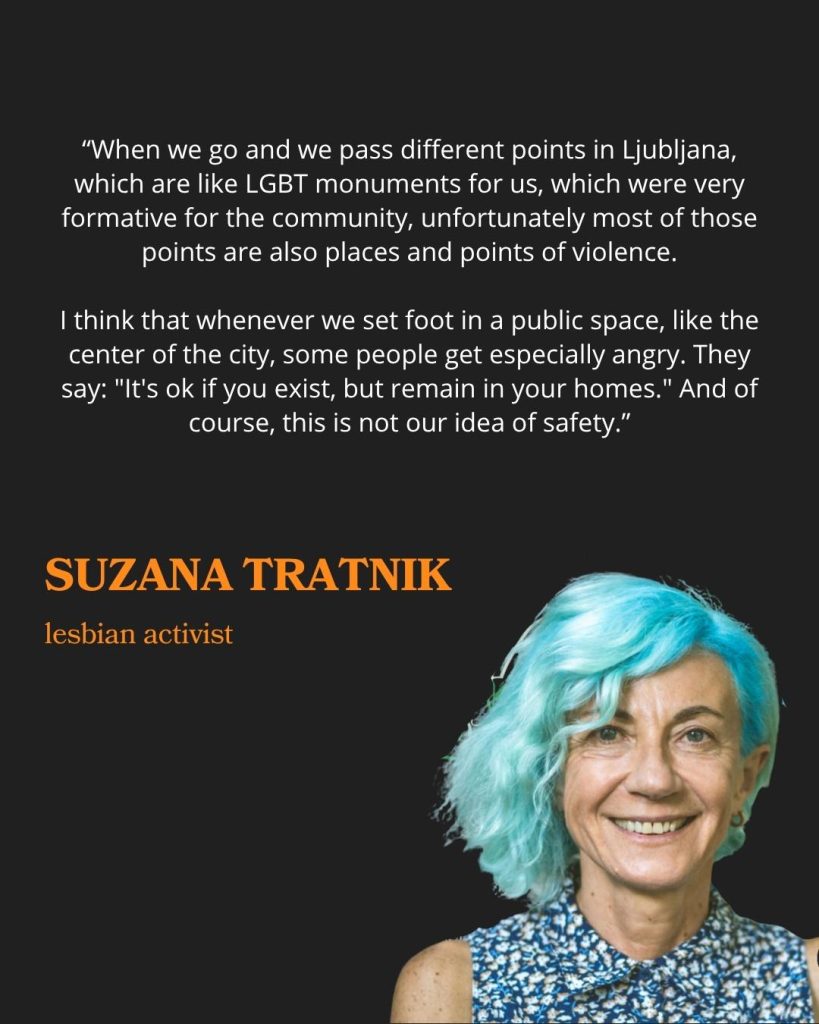
Suzana Tratnik
lesbian activist
Suzana Tratnik addresses the safety of public space by reclaiming the queer history of the city and making it a visible part of the urban narrative. Through her work as a writer and LGBT tour guide, she maps the geography of the community, turning streets and buildings into “monuments” of both resistance and trauma. She highlights the paradox of visibility, where naming a location as a “queer space” simultaneously creates a site of belonging and a target for harassment. Her work serves to document the anecdotes and memories of the movement, ensuring that the history of struggle for public space is not forgotten or erased.
She views the persistent occupation of the city center as a vital political act, challenging the idea that queer life should be relegated to marginalized or “hidden” areas.
She reflects on how the repeated restoration of community symbols, such as the nameplate of a park dedicated to a lesbian couple, acts as a measure of community stamina. Her approach focuses on the importance of staying in the open and refusing to return to the “private”, which society often demands. By documenting decades of harassment and resistance, she provides a historical context that empowers the community to keep taking up space in the present.
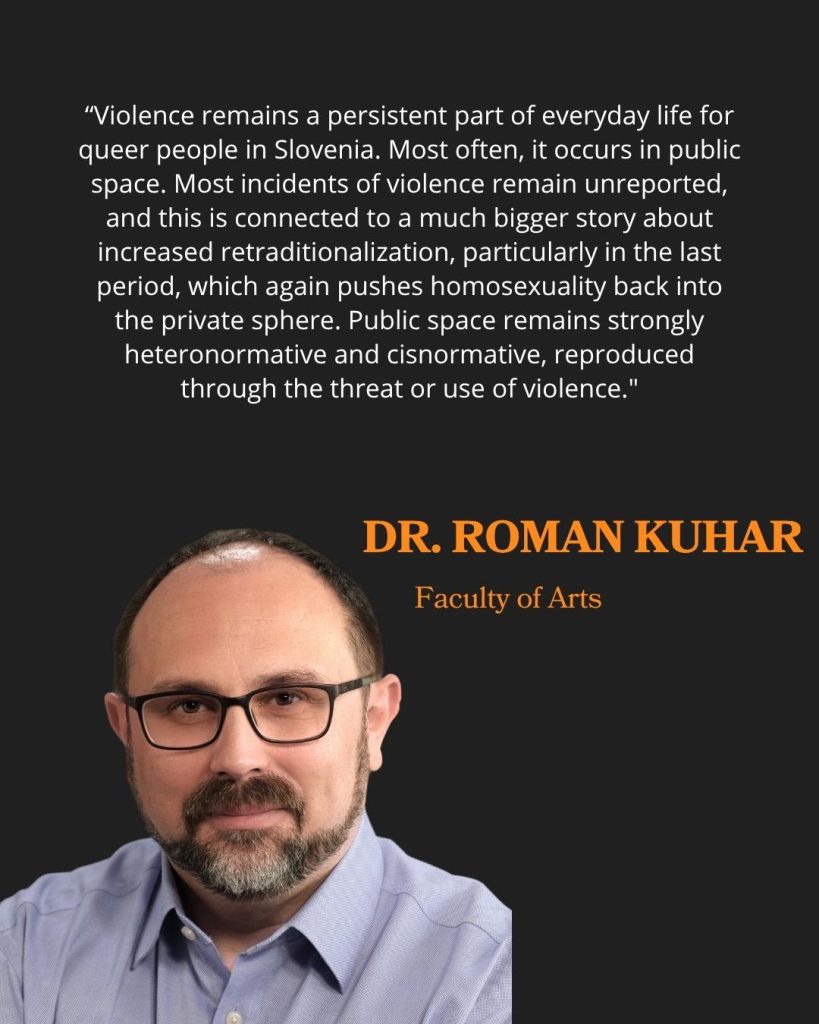
Dr. Roman Kuhar
Faculty of Arts
Roman Kuhar addresses queer safety through long-term sociological research that makes the persistent reality of violence visible to the public and policymakers. By systematically documenting the everyday lives of LGBT people in Slovenia over two decades, the team of researchers working on the studies provides the empirical evidence necessary to counter the institutional denial or minimization of queer experiences. The work tracks the shifting nature of public safety, noting that while private acceptance may fluctuate, public spaces remain sites where heteronormativity is enforced through the threat or use of violence.
The work also highlights the impact of the “anti-gender” movement on the broader social climate, linking political discourse to the increase in social distance and hostility. He advocates for continuous pressure on institutions, particularly the police and the judiciary, to ensure they fulfill their legal obligations to protect all citizens.
Roman argues that safety cannot be addressed in isolation; instead, we should work toward building broader coalitions with other marginalized groups. He views this cross-movement solidarity as essential for challenging the populist politics that create the conditions for violence in the first place.
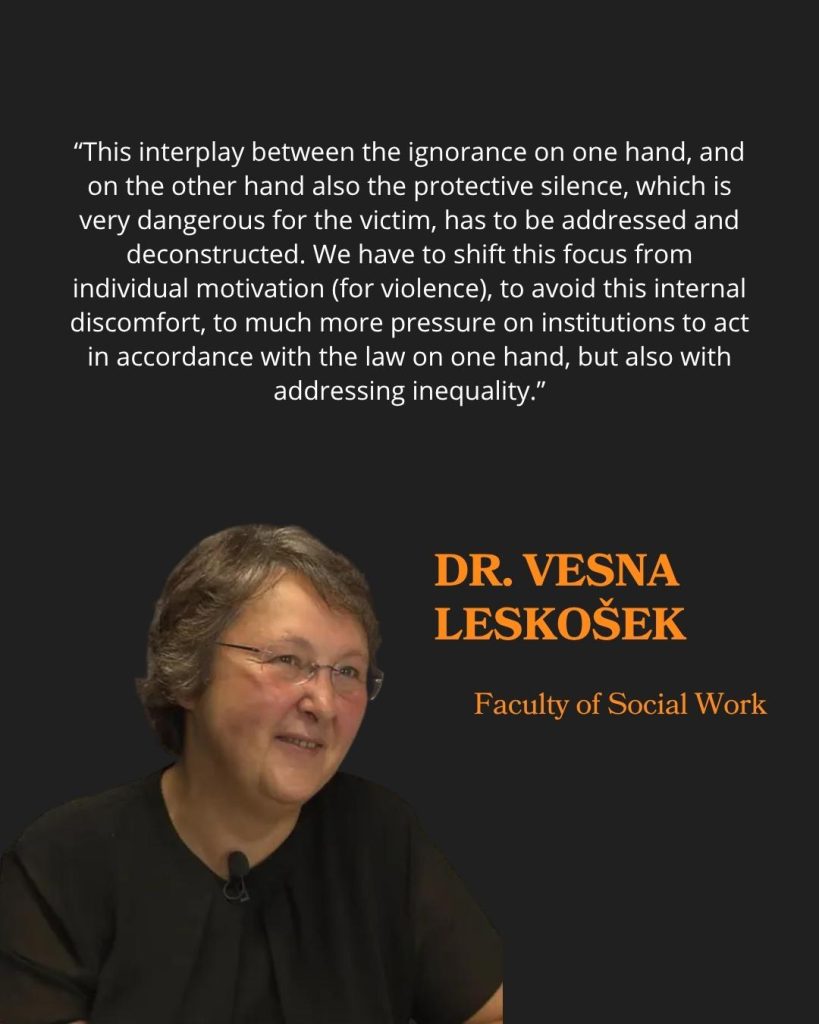
Dr. Vesna Leskošek
retired professor of Faculty of Social Work
Dr. Vesna Leskošek addresses queer safety by analysing and deconstructing the social and psychological mechanisms that allow violence to persist in silence. She identifies and analyzes “willful ignorance,” where institutions and society deliberately avoid acknowledging harm to escape their responsibility to act. Her research highlights how this institutional neglect forces victims into “protective silence”: a strategy where individuals withhold information about violence to protect themselves from further victimization or to shield their community from negative stigma. By naming these phenomena, she provides a framework for understanding why violence often remains unreported and invisible.
Her work advocates for a shift in focus from individual motivation to institutional accountability. She argues that safety can only be achieved when institutions are pressured to act in accordance with the principles of equality rather than simply following bureaucratic neutrality.
Her approach calls for a rigorous deconstruction of the defensive strategies used by both the state and the victims, aiming to create a landscape where violence is recognized and addressed rather than ignored.
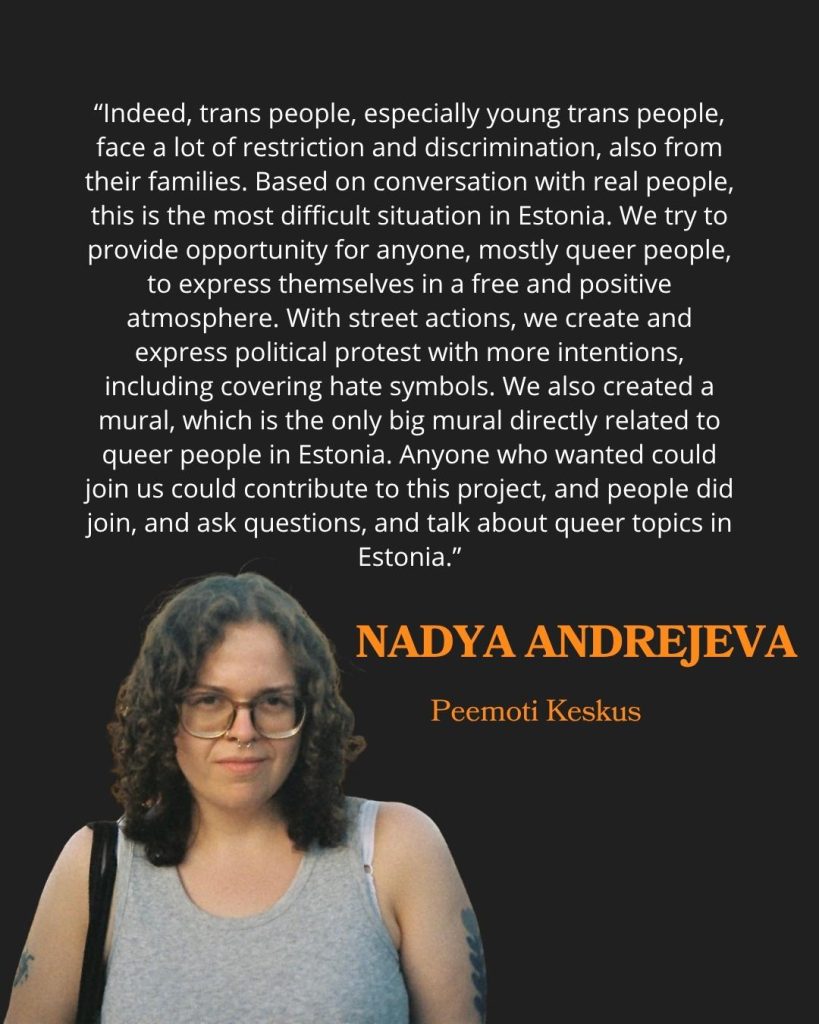
Nadya Andrejeva
Peemoti Keskus
Peemoti Keskus (Behemoth’s Center) in Tartu, Estonia, addresses safety through the creation of low-threshold, community-run spaces that provide a sanctuary for young people, particularly trans youth. At Behemoth’s Centre, they facilitate creative street actions that allow the community to take up space on their own terms, using art as a vehicle for political intention and local representation. Their work focuses on turning the city into a canvas for queer lives, whether through mural painting, workshops, or the covering of hate symbols, thereby providing the community with a sense of agency and ownership over their environment.
Nadya treats creative practice as a form of “resilience” that directly combats the isolation felt by those who feel unsafe on the streets. The work shows that public art projects not only build team strength but also open up avenues for direct dialogue with random passersby, demystifying queer presence in the city. By marking the city with landmarks of queer existence, they help build a public narrative that recognizes and celebrates the community’s presence.
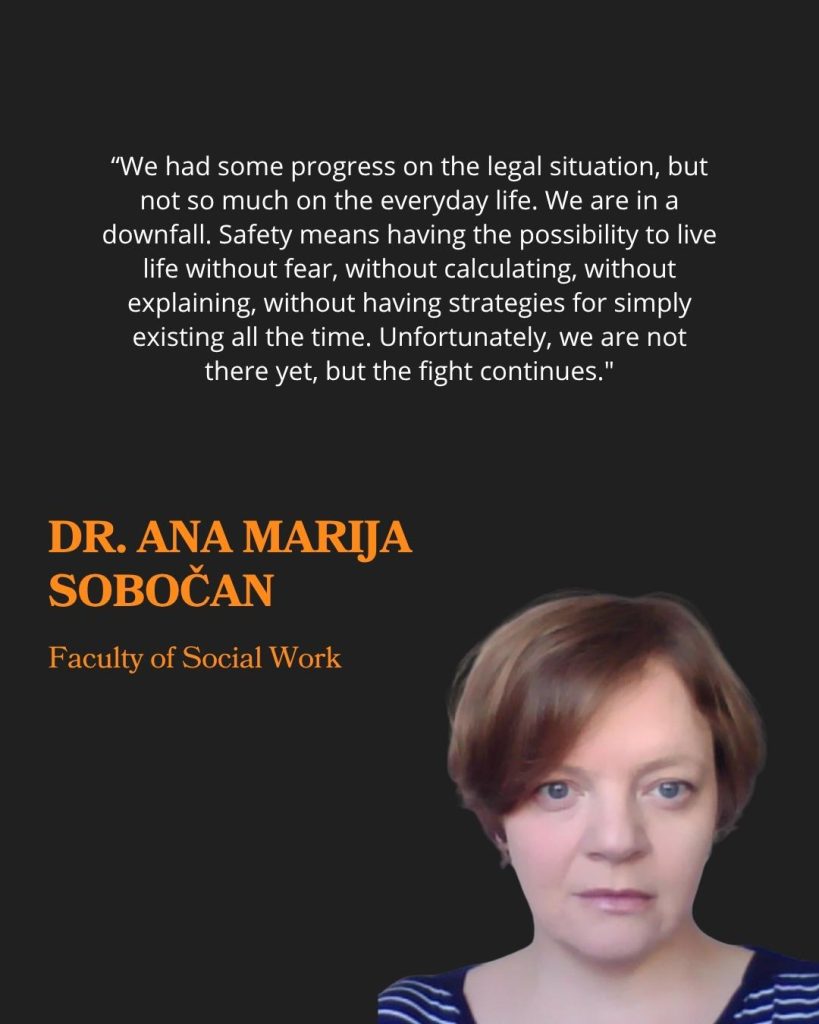
Dr. Ana Marija Sobočan
Faculty of Social Work
Dr. Ana Marija Sobočan addresses safety as a question of social and institutional responsibility rather than a burden for the individual to carry. Her work reframes safety from a series of personal “risk assessments” to a fundamental right to “ordinariness”: the ability to live an average daily life without the constant need for self-monitoring or strategic concealment. Drawing on her research with same-sex families, she illustrates how institutional assumptions and administrative silences create a form of “conditional visibility” that forces individuals to calculate the risk of their own existence in every public encounter.
Safety is built through institutional recognition and the proactive inclusion of diverse family structures and identities in all social systems. In an unequal society, “professional neutrality” only serves to reproduce existing harms. Schools, healthcare systems, and administrative bodies have the duty to create environments where everyone can belong without explanation. Sshe reflects on the emotional labor required to navigate an unwelcoming world, advocating for a societal shift where safety is guaranteed by the structure of public life itself, rather than by the caution of those within it.
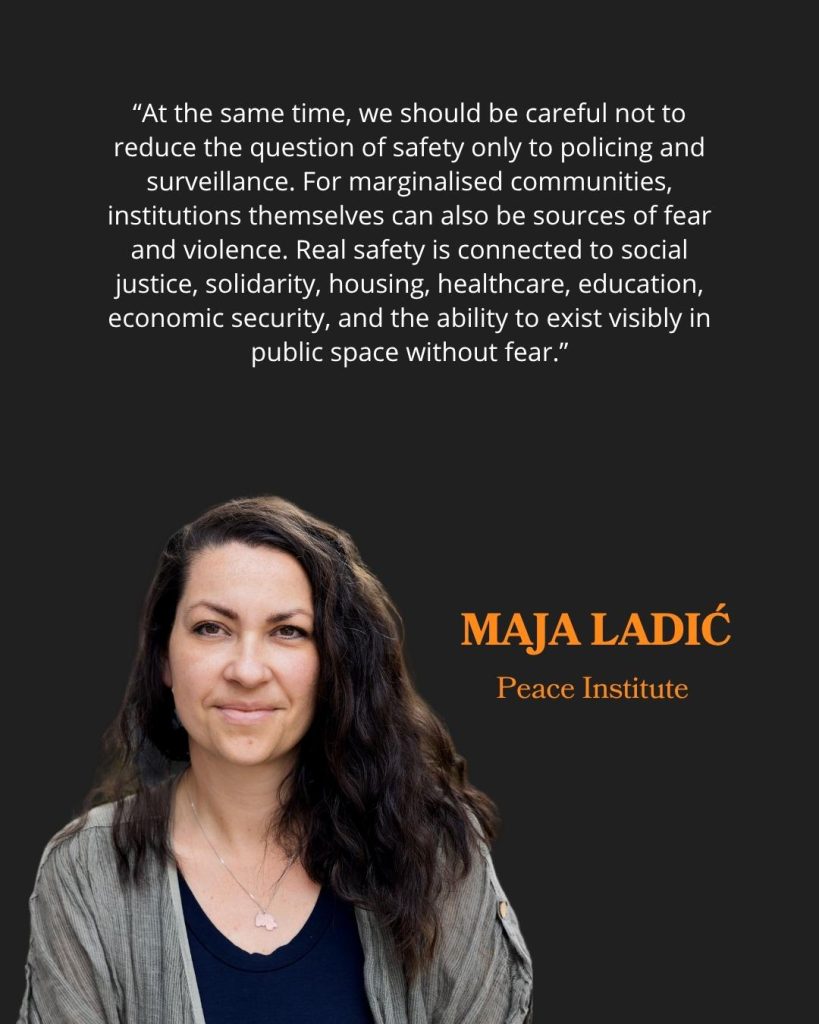
Dr. Maja Ladić
Peace Institute
Dr. Maja Ladić addresses the issue of safety by examining the structural gap between formal legal equality and the lived, everyday experience of the LGBTQ+ community. Through her research at the Peace Institute, she documents how symbolic legal progress in Slovenia often fails to translate into actual safety for the most marginalized, including trans individuals, migrants, and youth. Her work focuses on the “hidden scale” of violence—the constant hospitality, intimidation, and institutional neglect that force individuals into invisibility as a survival strategy. By mapping these intersectional realities, she provides a foundation for advocacy that demands more than just legislative change, focusing instead on the social conditions that allow hostility to exist in the first place.
In her work, she emphasizes the urgent need for accessible, community-based, and trauma-informed support systems that operate independently of state institutions. She argues that safety is not a matter of increased policing or surveillance, but is fundamentally linked to social justice, economic security, and the provision of specialized care that centers the victim’s needs. Her research also identifies worrying trends in peer dynamics, such as the rise of anti-gender narratives among youth. Public safety is achieved through the transformation of social conditions and the persistent creation of spaces for solidarity and collective resistance.
İrem Yetişgin
Institute My Rainbow
İrem addresses the issue of safety by examining the tools of resilience that are necessary for remaining visible in high-risk environments. Her perspective focuses on the importance of contextual adaptability—understanding that the strategies used in one country may not be safe or effective in another. She views resilience as a constant balancing act between the desire for public visibility and the need for personal and community protection. Her approach involves analyzing how the local political climate dictates the limits of what is possible, while still seeking ways to maintain a presence and a voice.
In the discussion, she highlighted how observing different regional strategies can serve as a source of inspiration for those in more restrictive contexts. She focuses on the psychological aspect of safety, noting that visibility is not just a physical act but a whole issue of identity that requires different tools for protection depending on the local landscape. Her work emphasizes the value of cross-border exchange, where sharing the successes and failures of safety strategies helps activists in diverse contexts build more robust networks of mutual support and resilience.

Rea Dizdarević
social work student
Rea opened the question of queer safety through a structural and intersectional lens, arguing that true safety cannot be achieved without dismantling the foundational power structures of society. As a social work student, she notices the “foundational awareness” required to recognize how homophobia, transphobia, and misogyny are embedded in systems like the patriarchy and capitalism. She argues that safety is not just a matter of changing individual behavior but of challenging the institutional apathy and desensitization that allows marginalized groups to remain at risk.
She emphasizes the need for a constant cycle of learning and debate within activist circles and educational institutions. The fight for queer safety is inseparable from other struggles for social justice, and we need a holistic understanding of how different forms of oppression reinforce one another. In her view, the first step toward public safety is breaking the “individualistic life propaganda” that isolates people. Instead, she wishes to work toward a collective awareness where individuals are equipped to challenge institutions and build the communities necessary for long-term survival and systemic change.